
Guide · Updated October 2026
Is CNC cabinetry better than traditional shop work?
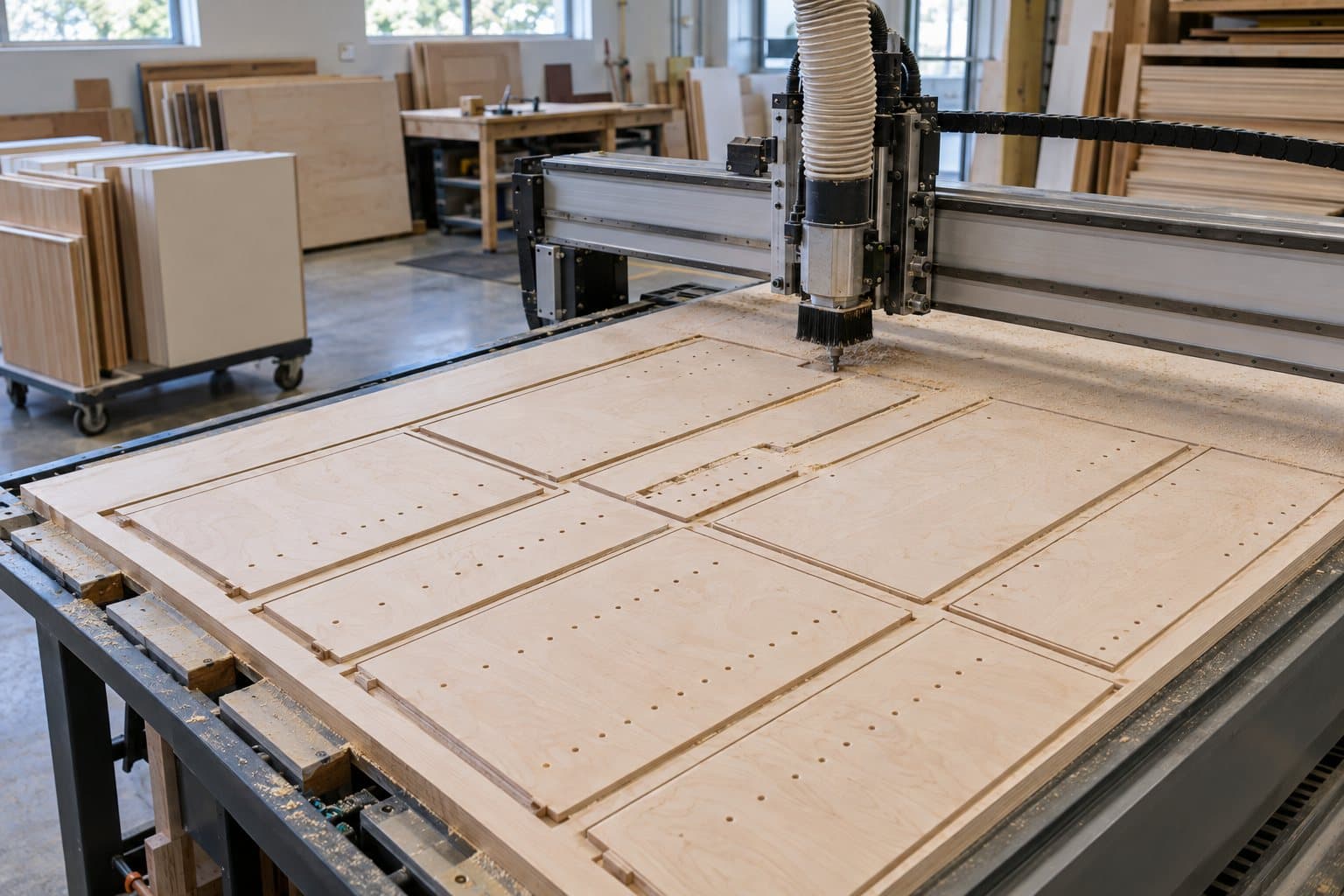
Is CNC-cut cabinetry better than traditional cabinet shop work?
| Part of the job | What the CNC changes | What still depends on people |
|---|---|---|
| Measuring | Nothing; the machine cuts what the file says | Measuring every wall and checking level and square |
| Design | Any size takes the same effort to cut | Layout, storage and proportions |
| Cutting box parts | Every part cut to the drawing, and repeatable | Choosing the sheet material |
| Drilling | Hinge, shelf-pin and hardware holes on a fixed grid | Choosing the hinges and drawer slides |
| Material use | Software nests parts tightly on each sheet | Choosing what gets cut from which sheet |
| Finishing | Nothing | Sanding, paint or stain, and clear coats |
| Assembly and install | Square parts make square boxes | Joining boxes, leveling, scribing, adjusting doors |
What does a CNC router do in a cabinet shop?
It cuts cabinet parts from full sheets of plywood or other panels by following a file made from the design, and drills the holes for hinges, shelf pins and hardware as it goes.
CNC stands for computer numerical control. Wikipedia describes a CNC router as a computer-controlled cutting machine: one program designs the part (CAD), another turns the design into the tool paths the machine follows (CAM), and cabinet making is one of its common uses. Industrial routers commonly have 4-by-8-foot or 5-by-10-foot tables (checked October 2026), big enough to cut a full 4-by-8 sheet of plywood in one setup.
The work that used to move from a table saw to a boring machine to a dado setup can happen in one program. ToolsToday, a router-bit supplier, describes CNC routers as well suited to nested-based manufacturing, where cabinet parts are cut directly from full sheets, and Techno CNC, a machine maker, lists cutting panels, drilling shelf-pin holes, cutting dadoes for backs and bottoms and routing hinge pockets among the jobs a router takes over (both checked October 2026).
What does CNC production improve?
Accuracy that repeats. Every part matches the drawing, every hole lands on the same grid, and a one-off size takes no more setup than a standard one.
- Square boxes and even gaps. Parts cut to the drawing assemble square, which keeps the small, even gaps between full-overlay doors consistent across a kitchen. More in frameless vs. face-frame cabinets.
- Holes on a grid. Most frameless cabinets follow the 32 mm system: 5 mm holes on 32 mm centers, with the first row 37 mm from the front edge (Wikipedia, checked October 2026). Hinge plates, drawer slides and shelf pins land on that grid without measuring each one.
- Any size for the same effort. Because every size comes from the drawing, a cabinet sized to 31 1/4 inches takes no more setup than a standard 30-inch box, and ToolsToday notes that one-off customization no longer means rebuilding jigs. That is what lets a custom shop fit cabinets to the wall instead of covering gaps with filler strips.
- Less waste. Nesting software lays parts out on each sheet to minimize scrap, and it can take the direction of the wood grain into account (Wikipedia, checked October 2026).
- Parts that match later. A vanity or mudroom built months after the kitchen can come from the same files and settings, so the details line up. See matching cabinets for the kitchen, bathroom and mudroom.
What does that mean for a kitchen remodel?
Mostly fit and consistency: cabinets sized to your walls instead of the nearest catalog width, even gaps along long runs, and doors and drawers that line up from one end of the kitchen to the other. Demolition, plumbing, electrical and countertops work the same way however the cabinet parts were cut.
In an older house, the measure and the install matter more than the machine. Walls that aren’t square and floors that aren’t level are handled by leveling the boxes and scribing fillers and panels on site, not by the CNC. See custom kitchen cabinets for how a kitchen is planned.
What doesn’t a CNC router decide?
Design, measuring, materials, finishing and installation. A CNC cuts exactly what the file says, so a wrong measurement becomes a wrong part, faster.
Machine makers describe CNC accuracy in strong terms; Techno CNC calls it “millimeter-perfect.” A tool supplier adds the caveat: ToolsToday’s guide says CNC “does not prevent errors. It scales them,” because a wrong dimension or a bad file can ruin a whole sheet, or several, before anyone notices. It also points out that the slowest and most important work has moved to measuring the space and drawing the cabinets (checked October 2026).
The rest of the quality comes from steps the machine never touches:
- Materials. A CNC can cut plywood, MDF, particleboard or melamine; what the boxes are made of is a separate choice.
- Assembly. How the boxes are glued, fastened, squared and hung on the wall.
- Finishing. Sanding, paint or stain, and the clear coats on doors and drawer fronts.
- Installation. Leveling, fastening, scribing fillers and panels to the walls, and adjusting every door and drawer.
Is CNC cabinetry cheaper?
Not automatically. CNC production saves shop time on cutting and drilling, but plywood, finishing, hardware and installation cost the same, and we haven’t found a reliable published figure for how much CNC saves.
Compare quotes on the same specification: box material, door style, finish, hardware and what’s included. Our Colorado custom cabinet cost guide lists published price ranges. Woodridge packages start at $750, $1,050 and $1,450 per linear foot, installed in Boulder County, as of October 2026.
Can a CNC shop build face-frame and inset cabinets?
Yes, though frameless is the more natural fit. Every frameless part is a flat panel the router can cut and drill; a face frame adds solid-wood stiles and rails that are milled, joined and attached as separate steps.
We build both: frameless (full-access) boxes as standard and, for traditional kitchens and older homes, face-frame cabinets, including inset doors. See frameless vs. face-frame cabinets for how they differ.
How do you judge a cabinet shop, CNC or not?
Ask about the things you can check: what the boxes are made of, how they are joined, what finish goes on the doors, which hardware is used, who measures and installs, and whether you approve drawings before anything is cut.
- What are the boxes made of, and how thick are the sides?
- How are the boxes joined and fastened, and how are wall cabinets hung?
- What finish goes on painted and wood doors? Painted cabinets need a hard, cabinet-grade coating, not wall paint.
- Which hinges and drawer slides are used, and do the drawers open all the way?
- Who measures the room, and who installs the cabinets?
- Do you get dimensioned drawings to approve, and a written price for exactly what’s drawn?
Certification is one outside benchmark. The Kitchen Cabinet Manufacturers Association says cabinets certified to its A161.1 standard pass 14 tests, including a 600-pound load test, and that certified cabinets exist at every price point (checked October 2026). If a shop isn’t certified, ask for its build standard in writing. Our custom vs. semi-custom vs. stock guide covers what else separates the tiers.
How does Woodridge Cabinets use its CNC?
To cut and drill every cabinet box part from the drawings you approve. Measuring, design, finishing and installation are people’s work, and each step ends with something you can see or approve.
We measure every wall at several heights and check how level and square the room is, then draw the layout as 3D views and dimensioned elevations. Once you approve the drawings, they become cut files: the CNC router cuts and drills every box part from plywood sheets, then the boxes are assembled, the doors and drawer fronts are made and finished, and the hardware is fitted. Our standard is frameless (full-access) boxes in 3/4" plywood, with Blum soft-close hinges and Blum full-extension, soft-close undermount drawer slides.
See our process, kitchen cabinets and packages, or request a quote.
CNC cabinet questions
What does CNC mean for cabinets?
CNC stands for computer numerical control. A CNC router is a computer-controlled cutting machine; in a cabinet shop it cuts and drills cabinet parts from sheets of plywood, MDF or other panels by following a file made from the design.
Are CNC cabinets better quality than traditionally made cabinets?
For the precision of the parts, usually yes, because every cut and hole comes from the drawing. Overall quality still depends on the materials, assembly, finish and installation, which a CNC doesn’t decide. A careful shop with conventional machines can build excellent cabinets, and a careless one with a CNC can build poor ones.
Do CNC-made cabinets look mass-produced?
No. A CNC cuts whatever sizes the design calls for, so a one-off cabinet is as easy to make as a standard one. The look comes from the door style, finish, wood and layout, not from how the box parts were cut.
Are CNC cabinets made of solid wood?
Usually not the boxes. CNC routers in cabinet shops mostly cut sheet goods such as plywood, MDF, particleboard and melamine. Ask any shop what its boxes and doors are made of; Woodridge Cabinets builds 3/4" plywood cabinet boxes.
Are CNC-made cabinets cheaper?
Not automatically. CNC production saves shop time on cutting and drilling, but plywood, finishing, hardware and installation cost the same. We haven’t found a reliable published figure for how much CNC saves, so compare quotes on the same specification.
Can a CNC fix an out-of-square wall?
No. A CNC makes square boxes; fitting them to a wall that isn’t square happens at the measure, in the design and during installation, with fillers and panels scribed to the wall.
Does Woodridge Cabinets build every cabinet on a CNC?
Yes. Every cabinet box part is cut and drilled on a CNC router from the drawings you approve. The boxes are then assembled, the doors and drawer fronts are made and finished, and you choose installation by our own crew, or delivery to your contractor.
Tell us about your project
Send a few details and rough measurements. Sam replies within one business day with next steps and a ballpark range.