
Guide · Updated October 2026
Frameless vs. face-frame cabinets
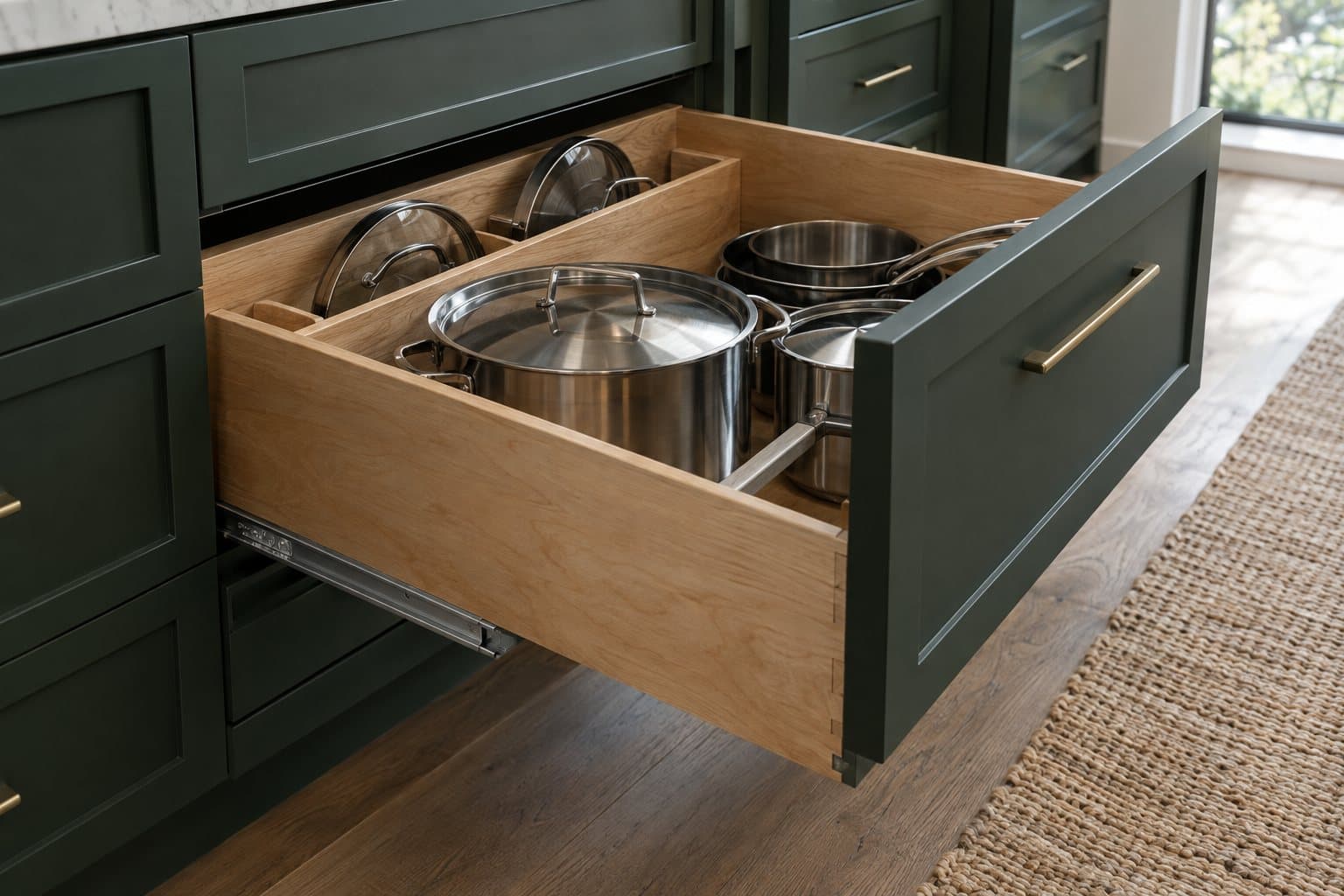
What is the difference between frameless and face-frame cabinets?
| Feature | Frameless | Face frame |
|---|---|---|
| Front of the box | Edgebanded panel edges; no frame | Solid-wood frame of stiles and rails |
| Access to the interior | Full opening; no center stile between doors | Frame narrows the opening; many two-door cabinets have a center stile |
| Typical door overlay | Full overlay | Partial overlay, full overlay or inset |
| Hinges | Concealed cup (Euro) hinges on the box side | Concealed face-frame hinges, or exposed hinges on many inset doors |
| Where strength comes from | Thick box sides, a secure back and solid installation | The frame stiffens the front against racking |
| Installation | Needs square, level boxes; fillers and scribe strips at walls | The frame edge can be scribed to uneven walls |
| Typical style | Modern, slab and clean Shaker | Traditional, farmhouse and inset |
| Cost | Sources disagree (see below) | Sources disagree (see below) |
| Fit with CNC production | Strong: flat panels and 32 mm hole patterns | Frame adds solid-wood milling and assembly steps |
How is a frameless cabinet built?
A frameless cabinet is a box of flat panels, usually plywood, particleboard or MDF, with edgebanding on the front edges and no frame. Doors and drawer slides mount directly to the box sides (Wikipedia, Lowe’s; checked October 2026).
Most frameless cabinets follow the 32 mm system, also called the European system, which developed in Europe after World War II. According to Wikipedia’s entry on the system (checked October 2026), its signature is columns of 5 mm holes on 32 mm centers, with the first row 37 mm from the front edge. Hinge plates, drawer slides and shelf pins all land on that grid, so parts and hardware line up without measuring each one.
Without a frame, the box carries the load. HomeAdvisor notes that frameless construction relies on a heavier box to hang the doors (checked October 2026). Good frameless boxes use 3/4-inch panels with a solid back or hanging rails, and they have to be installed square and level.
How is a face-frame cabinet built?
A face-frame cabinet is a box with a frame of vertical stiles and horizontal rails, usually solid hardwood, fastened to the front. Doors and drawers hang on or inside that frame.
Lowe’s calls framed cabinets the most common type in the U.S. and says the frame extends up to 2 inches over the cabinet opening (checked October 2026). The frame allows three door options: partial overlay, which Lowe’s says leaves 1 to 1 1/4 inches of frame showing; full overlay, which leaves up to 1/4 inch; and inset, where doors sit flush inside the frame.
Which gives you more storage?
Frameless. With no frame lip and no center stile, the full width of the box is open, so drawers can be wider and large items slide straight in.
In a face-frame cabinet, drawer boxes and roll-outs have to clear the frame, so they are narrower than the cabinet’s inside width. Wikipedia’s entry on frameless construction makes the same point: removing the front frame leaves more room for large objects and more usable space. The difference shows most in drawer bases, sink bases and narrow cabinets, where a frame overlap of up to 2 inches takes a big share of the opening. See kitchen cabinets for how drawer-heavy layouts use that space.
How do frameless and face-frame cabinets look different?
Frameless cabinets show only doors and drawer fronts, with small, even gaps between them. Face-frame cabinets either show the frame around each door or, with inset doors, frame each door like a piece of furniture.
Full overlay on a frameless box reads modern with slab doors and clean with Shaker doors, like the drawer stack pictured above. Door style and box construction are separate choices: HomeAdvisor points out that Shaker is a style choice for doors and drawer fronts, not a material difference. Face frames suit traditional, farmhouse and period kitchens, especially with inset doors, which are traditionally a face-frame detail.
What hinges does each type use?
Frameless cabinets use concealed cup hinges, often called Euro hinges, mounted to the box side. Face-frame cabinets use concealed hinges made for frames, or exposed hinges on many inset doors.
A cup hinge sits in a round recess bored into the back of the door and clips to a plate on the cabinet. Wikipedia notes that concealed hinges were developed in Europe, use metric installation standards and can be adjusted in place with two screws, which is how installers get even gaps. HomeGuide lists which hinge each overlay needs (full overlay doors require concealed hinges; inset doors use concealed or exposed hinges) and puts hinges at $2 to $10 or more each before installation (checked October 2026). Soft-close is a feature of the hinge, so it is available on both styles.
Which is more durable, and which is easier to install?
Both hold up well when they are built well. Frameless depends on a rigid, square box; a face frame adds stiffness and gives the installer a solid-wood edge to fit against uneven walls.
A frameless box has no frame to resist racking, so its strength comes from 3/4-inch sides, a secure back, tight joinery and fastening to the wall and to the cabinets beside it. If a box is out of square, it shows right away as uneven door gaps.
A face frame stiffens the front, ties neighboring boxes together and can be scribed (trimmed to match) to a wavy wall or an out-of-plumb corner. That forgiveness is one reason face frames stay popular in older houses.
Does Colorado’s dry climate matter?
More for solid wood than for sheet goods. Solid wood shrinks and swells across the grain as indoor humidity changes, and Colorado air is dry, especially in winter with the heat running. That movement can open hairline gaps where face-frame joints or five-piece door frames meet, which shows most on painted cabinets. Plywood and MDF move much less; HomeAdvisor notes that plywood with real-wood veneers resists warping and shrinking better than solid lumber (checked October 2026). Frameless boxes are all sheet goods, while face frames add a solid-wood part.
Which costs more, frameless or face-frame?
Published sources disagree. HomeGuide says frameless or full-overlay cabinets cost 20% to 50% more than framed cabinets; HomeAdvisor puts framed kitchens at $5,000 to $20,000 or more and frameless at $6,000 to $30,000 or more (both checked October 2026).
Inset costs the most in both sources: HomeGuide says up to twice as much as framed, and HomeAdvisor says about 20% more. Price also follows production method. A shop tooled for face frames may charge more for frameless, while a shop built around sheet goods and CNC skips the frame-making step entirely. See how much custom cabinets cost in Colorado for overall ranges.
Which construction suits CNC production?
Frameless. Every part is a flat panel, so a CNC router can cut it, drill the 32 mm hole rows and bore hardware positions straight from the design file.
The 32 mm system grew up around machine production: Wikipedia notes that the 32 mm spacing came from how closely drill bits could be placed on line-boring machines, and that the system simplifies dimensions and production for hardware, machine and furniture makers. A face frame adds solid-wood steps outside that flow: milling stiles and rails, joining them, attaching the frame and sanding it flush. Shops do build face frames with CNC help, but frameless is the more natural fit. Our custom vs. semi-custom vs. stock guide covers where a CNC custom shop sits among the tiers.
Which type does Woodridge Cabinets build?
We build both. Frameless is our standard: frameless (full-access) boxes made from 3/4" plywood cabinet boxes, with Blum soft-close hinges and Blum full-extension, soft-close undermount drawer slides. For traditional kitchens, older homes and anyone who wants inset doors, we also build face-frame cabinets, including inset doors. Door styles are Shaker, Slim Shaker, Slab, in full overlay on frameless boxes or inset on face frames.
See kitchen cabinets for what a frameless kitchen includes, our process for how a job runs, and packages for how options are grouped. When you are ready, request a quote.
Frequently asked questions
Are frameless cabinets as strong as face-frame cabinets?
Yes, when the box is built well. Frameless cabinets rely on thick sides, usually 3/4-inch panels, a secure back and firm fastening to the wall and to each other. A face frame adds stiffness at the front, which makes face-frame cabinets more forgiving of thinner boxes.
Do frameless cabinets have more storage space?
Yes. With no face frame and no center stile, the whole opening is usable, so drawers can be wider and large pots and sheet pans slide straight in. Lowe’s notes that a face frame can extend up to 2 inches over the cabinet opening.
Can frameless cabinets have inset doors?
They can, but it is less common. Inset doors are traditionally a face-frame detail, and inset costs more in either style; HomeGuide says inset cabinets can cost up to twice as much as framed cabinets.
Are frameless cabinets more expensive than face-frame cabinets?
Published sources disagree. HomeGuide says frameless or full-overlay cabinets cost 20% to 50% more than framed; HomeAdvisor gives overlapping kitchen ranges of $5,000 to $20,000 or more for framed and $6,000 to $30,000 or more for frameless. The price depends heavily on how a given shop is set up to build.
What hinges do frameless cabinets use?
Concealed cup hinges, often called Euro hinges. The cup sits in a round recess bored into the back of the door and clips onto a plate on the cabinet side. Screws on the hinge adjust the door in place, and soft-close versions are common.
Does Colorado’s dry climate affect cabinets?
It mostly affects solid wood. Solid-wood face frames and five-piece door frames shrink and swell as indoor humidity changes, which can open hairline gaps at the joints, especially on painted cabinets. Plywood and MDF panels move much less.
Tell us about your project
Send a few details and rough measurements. We'll reply with next steps and a ballpark range.