
Laundry & mudroom
Custom laundry and mudroom cabinets
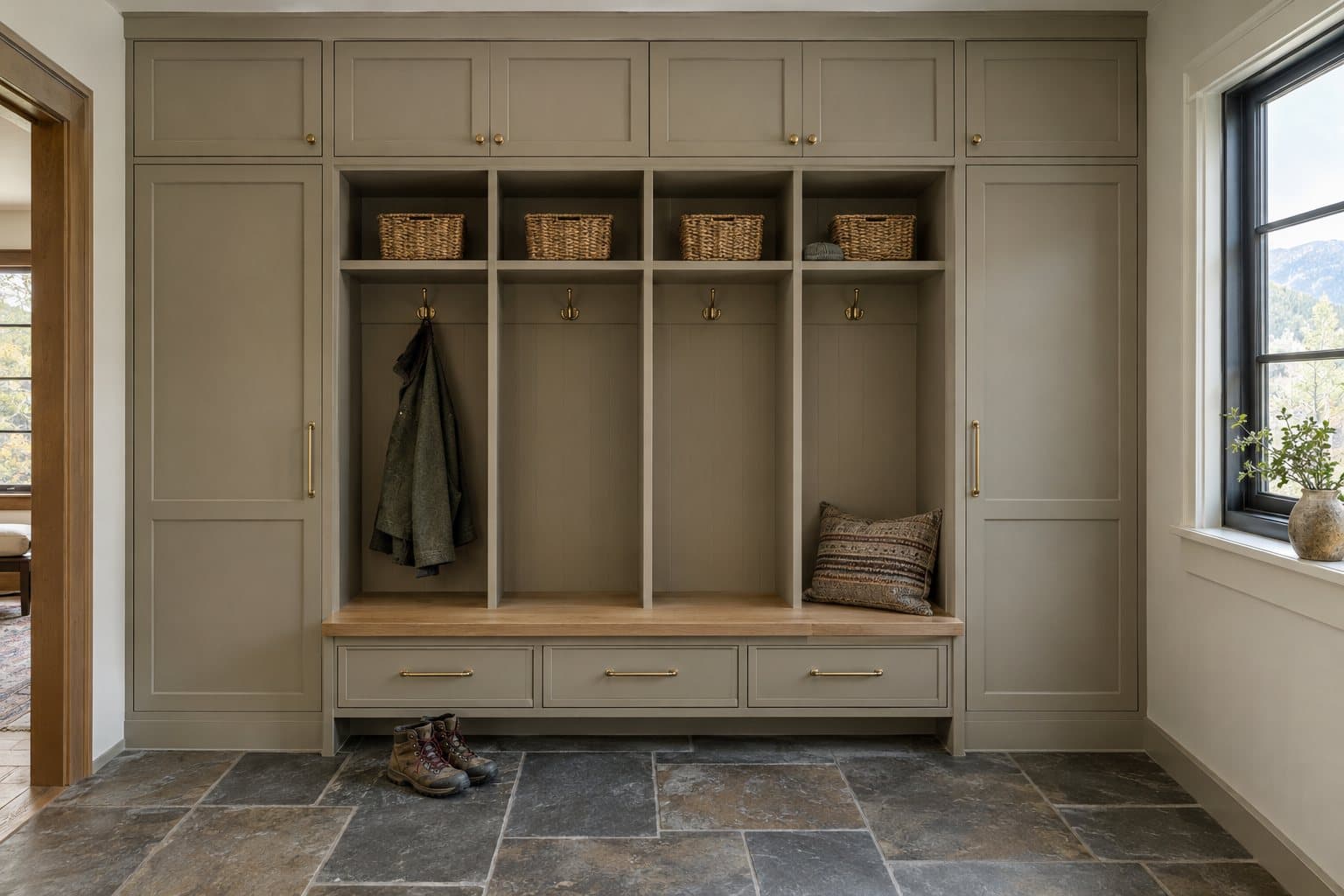
What should custom mudroom and laundry cabinets include?
How high and deep should a mudroom bench be?
Make the seat about 18 inches high and 16 to 20 inches deep. That’s chair height for pulling on boots, with room underneath for a boot tray or cubbies.
If you plan a cushion, lower the bench by its thickness so the seat still lands near 18 inches. Drawers under the bench are faster to use than a lift-up lid, which nobody can open while someone is sitting on it. Give the bench top a hard-wearing finish; it takes wet boots, groceries and sports bags.
How wide should built-in mudroom lockers and cubbies be?
Plan 15 to 24 inches per person. Eighteen inches is a common width that holds a winter coat and a backpack; adults usually want more room than kids.
A typical locker runs from the bench to about head height with hooks inside, plus a cubby or cabinet above for hats, gloves and off-season gear. Open lockers are faster to use; doors hide clutter but trap moisture. Matching the locker depth to the bench gives one clean front.
| Bench seat height | About 18 inches, including any cushion |
|---|---|
| Bench depth | 16–20 inches |
| Locker or cubby width | 15–24 inches per person; 18 inches is common |
| Adult hooks | About 60–66 inches off the floor |
| Kids’ hooks | About 40–48 inches off the floor |
How high should mudroom hooks go?
Put adult hooks about 60 to 66 inches off the floor and a second row around 40 to 48 inches for kids. Double hooks give each person a spot for a coat and a bag.
Screw hooks into the locker’s back panel or a mounting rail, not just drywall, so a loaded backpack doesn’t pull them out. Space them far enough apart that one puffy coat doesn’t bury the next.
How do you store wet boots and gear?
In the open. A removable boot tray or slatted shelf under the bench lets snowmelt drain and air move; wet gear shut behind solid doors stays damp.
Boulder County winters bring snow, slush and road de-icer onto boots, and spring brings mud, so the bottom of a mudroom built-in takes the most abuse. A few things help:
- Open or slatted shelves under the bench, with a tray you can carry to the sink.
- Airflow in any doors used for gear: open backs, gaps, or slatted or perforated panels.
- Baskets for gloves and hats that can come out to dry.
- An outlet for a boot dryer. That’s electrical work; permits depend on the scope, and your contractor handles it.
What finish holds up to Colorado snow and mud?
A hard, fully sealed finish on every surface, with extra attention to the bench top, toe kick and lower panels, which take kicks and meltwater all winter.
Painted cabinets are easy to touch up, but chips show on very light colors; mid-tone and darker paints hide grime better. White oak hides scuffs well. Under the finish, plywood handles occasional wetting better than particleboard, which swells at wet edges. We build mudroom and laundry cabinets with 3/4" plywood cabinet boxes.
How high should cabinets be above a washer and dryer?
Start from your machines: measure their height, including any pedestals, add room to load them and to open a top-loader’s lid all the way, then set the upper cabinets above that. Front-loaders let you hang uppers lower than top-loaders do.
Two more clearances matter. Leave space behind the machines for hoses and the dryer vent; the installation manual lists the minimum. And keep the uppers reachable: you lean over a deep machine to get to them, so shelves set too high go unused. Standard 12-inch-deep uppers are plenty for detergent and supplies.
Can you put a folding counter over front-load machines?
Yes. A counter spanning side-by-side front-loaders turns the space above them into a folding surface, as long as there’s a gap above the machines and they can still slide out for service.
The counter is supported by cabinets or panels at each end, not by the machines, and it often ends up higher than a 36-inch kitchen counter, depending on the machines. With top-loaders or a stacked pair, put the folding counter on base cabinets beside them instead.
Where does a hanging rod go in a laundry room?
Somewhere you can hang shirts straight out of the dryer, with about 40 inches of clear space below the rod for shirts and more for dresses or coats.
Common spots are a tall open section at the end of the cabinet run or a rod under the upper cabinets over open floor. A rod above a counter only works for short items. A pull-out valet rod inside a cabinet is a compact alternative.
Should a laundry room have a sink cabinet?
If you can get water and a drain to it, yes. A deep utility sink in a base cabinet handles stain soaking, hand-washing and muddy gear from the mudroom.
The sink base gets wetter than any other laundry cabinet, so build it from plywood and seal every surface. Adding a sink where there isn’t one is plumbing work: permits depend on the scope, and your contractor handles it.
Is a pull-out hamper worth it?
Usually. A pull-out hamper in a base cabinet keeps dirty laundry out of sight next to the machines, and two bins let you sort lights and darks as you go.
Hampers need a base cabinet wide enough for the bins and full-extension slides so the bins clear the counter when you lift them out. Our cabinets use Blum soft-close hinges and Blum full-extension, soft-close undermount drawer slides.
Should laundry and mudroom cabinets match the kitchen?
Usually, because mudrooms and laundry rooms often open right off the kitchen. Using the same door style and finish makes them read as part of the same house.
We keep a short list so any room can match. Door styles: Shaker, Slim Shaker and Slab. Finishes: painted (a curated palette), natural white oak, stained white oak and walnut. A hard-wearing paint color in the mudroom, with the same door style as a white oak kitchen, also works. See kitchen cabinets and our cabinet packages.
What does a custom mudroom or laundry room cost?
It depends on the length of the run, how many tall lockers and drawers you want, and the wood and finish. Our packages start at $450 per linear foot installed; send rough measurements for a ballpark.
For typical Colorado market ranges, read how much custom cabinets cost in Colorado. Our process explains each step. Plan on about 8–10 weeks from signed design to install, with installation by our own crew, or delivery to your contractor.
Frequently asked questions
What is the standard height of a mudroom bench?
About 18 inches to the top of the seat, the same as a dining chair. If you plan a cushion, build the bench lower by the cushion's thickness.
How deep should a mudroom bench be?
16 to 20 inches is comfortable to sit on and leaves room underneath for a boot tray, cubbies or drawers.
How wide should mudroom lockers be?
15 to 24 inches each. 18 inches is a common width that holds a winter coat and a backpack, and adults usually want more width than kids.
How much space do you need above a washer and dryer for cabinets?
Enough to load the machines and, for a top-loader, to open the lid all the way. Measure your machines, check the clearances in the installation manual, then set the upper cabinets above that.
Can you build cabinets around a stacked washer and dryer?
Yes. A tall surround with cabinets above and beside the stack works well, as long as it leaves the manufacturer's clearances so the machines can vent, vibrate and be pulled out for service.
Should mudroom cabinets have doors?
Use doors up high for seasonal gear and keep the lower area open. Wet coats and boots dry faster with air around them, so solid doors work best where nothing goes in wet.
Can I add a sink to my laundry room?
Often, if water and a drain are nearby. Permits depend on the scope; plumbing changes usually need one, and your contractor handles it. The sink base should be plywood with every surface sealed.
Can my mudroom and laundry cabinets match my kitchen?
Yes. These rooms often open right off the kitchen, so using the same door style and finish makes them look like part of the same house.
Tell us about your project
Send a few details and rough measurements. We'll reply with next steps and a ballpark range.