
Boulder, Colorado
Custom cabinets in Boulder, CO
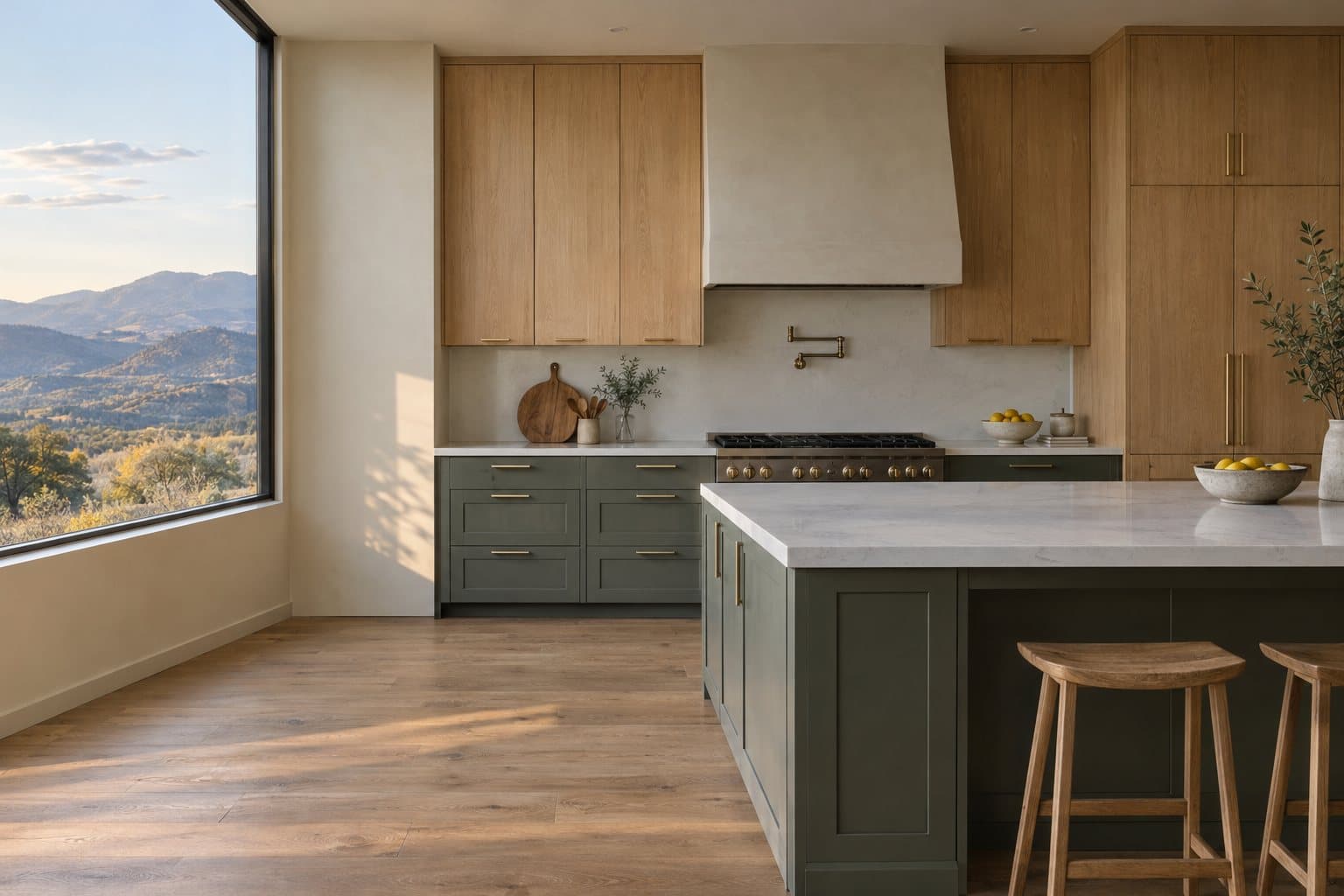
Who builds custom kitchen cabinets in Boulder?
What kinds of homes do Boulder cabinets need to fit?
Mostly established houses from two eras: late-1800s and early-1900s homes in the central neighborhoods, and the ranches, split-levels and bi-levels of the postwar boom.
The oldest housing is near downtown. Mapleton Hill is one of the city’s 10 local historic districts, designated in 1982 (City of Boulder, checked October 2026). East of downtown, Whittier mixes Victorians with bungalows and Craftsman cottages from the 1900s through the 1920s (Your Boulder neighborhood guide, checked October 2026).
Then the city grew fast. Boulder went from 12,958 residents in 1940 to about 72,000 by 1972, and most new homes were Ranch, Split-Level and Bi-Level houses in subdivisions such as Martin Acres and Table Mesa, according to the city’s postwar residential architecture survey (checked October 2026).
Along the way, Boulder also limited outward growth: the 1959 Blue Line restricted city water service on the mountain backdrop, voters approved an open space sales tax in 1967, and a residential growth-management ordinance followed in 1976 (Wikipedia, checked October 2026). For cabinets, the practical result is that most Boulder kitchen work happens inside existing houses, not new construction.
How do custom cabinets fit an older Boulder house?
By measuring the room as it really is, building every cabinet to an exact size, and scribing fillers, end panels and trim to the walls, floor and ceiling. Older houses are rarely square, level or plumb, and good cabinets hide that instead of fighting it.
In a 100-year-old house, plaster walls bow, floors slope and ceilings drift out of level. The fix is a measure at several heights along each wall, base cabinets leveled on adjustable legs so the countertop ends up flat, and scribe strips or finished panels cut to follow the wall’s real line.
Kitchens in these houses also tend to be small and broken up by doors, windows and chimneys. Custom sizing makes them work: any width instead of the 3-inch steps of stock lines, uppers to the ceiling, drawers instead of doors in the base cabinets, and a 12- to 15-inch-deep pantry cabinet on a wall too narrow for anything else. See how we plan custom kitchen cabinets for small rooms.
A plain Shaker door looks at home in a bungalow, and new built-ins and pantry cabinets can be drawn to sit alongside an original buffet or bookcase.
What changes when you redo a kitchen in a mid-century ranch or split-level?
Usually the layout. Kitchens from the 1950s–70s are often closed off, with soffits above the uppers and short runs of counter, so new cabinets tend to go with removing soffits, opening a wall or adding an island or peninsula.
Before planning cabinets to the ceiling, find out what’s inside the soffits: some are empty framing, others hide ducts or plumbing that would need rerouting. Opening a wall can involve a beam and a permit, which your contractor handles. In split-levels the kitchen often shares walls with the stairs, so tall cabinets need careful placement.
On style, the clean lines of a mid-century house suit flat doors. A slab door in walnut or white oak, or a Slim Shaker with a narrow frame, fits the period without copying it. Our standard door styles are Shaker, Slim Shaker and Slab, and our finishes are painted (a curated palette), natural white oak, stained white oak and walnut. If you’re weighing construction types, read frameless vs. face-frame cabinets.
Does Boulder’s dry climate affect wood cabinets?
Yes. Solid wood shrinks when the air dries out and swells when it gets humid. Boulder sits at about 5,430 feet at the base of the foothills with a semi-arid climate (Wikipedia, checked October 2026), and indoor air gets especially dry in winter once the furnace runs.
Plywood boxes and flat panels move far less than solid wood. On a five-piece Shaker door, the center panel floats in a groove so it can expand and contract without stressing the frame, and doors and parts should acclimate in the house before install. On painted doors, a hairline at the frame joints in winter is normal movement, not a defect. Our standard is frameless (full-access) boxes built from 3/4-inch plywood.
Do you build for homes in the foothills and canyons outside Boulder?
Yes. Those homes are in Boulder County, our service area, and the extra planning is mostly access: getting finished cabinets up a mountain road, a steep driveway or a tight stair without damage.
Describe the road, the driveway and the path from the truck to the kitchen when you request a quote, so islands and tall pantry cabinets can be built in sections if needed. In winter, mountain deliveries are scheduled around the weather.
Do I need city approval for a kitchen remodel in a Boulder historic district?
For the outside of the house, yes. The city requires a Landmark Alteration Certificate for all exterior changes to individual landmarks and properties in its historic districts (City of Boulder, checked October 2026), so a remodel that adds a window, moves a door or runs a range-hood vent through an exterior wall goes through that review.
Building permits are separate and depend on scope; moving plumbing, adding circuits or removing walls usually needs one, and your contractor handles it. Check the city’s historic districts and landmarks map to see if your house is in a district.
What else can you build for a Boulder home?
Kitchens come first, and the same door style and finish can carry into other rooms so the house reads as one project.
- Bathroom vanities, 30 to 36 inches tall, including floating vanities for small older bathrooms.
- Laundry and mudroom cabinets, with a bench about 18 inches high and lockers for skis, bikes and boots.
- Pantries and built-ins, including bookcases and window seats.
How does a Boulder project start?
With a quote request. Send photos and rough measurements through the quote form; we reply with a ballpark range, then measure your home. Lead time is about 8–10 weeks from signed design to install. See our process, what custom cabinets cost in Colorado and custom vs. semi-custom vs. stock.
Boulder custom cabinet questions
How much do custom kitchen cabinets cost in Boulder?
It depends mostly on how many linear feet of cabinets the kitchen needs, how many drawers and tall cabinets are in the plan, and the door style and finish. Our custom cabinet cost guide explains price per linear foot and what moves the number. Woodridge Cabinets packages start at $450 per linear foot installed (Essential), $650 (Select) and $900 (Signature), so a typical 20-foot kitchen starts around $9,000; a quote request gets you a ballpark for your room.
Can custom cabinets fit an old Boulder house with uneven walls and floors?
Yes, and that is one of the best reasons to go custom in an older house. Cabinets are leveled on adjustable bases so the countertop sits flat even when the floor doesn't, and filler strips, end panels and trim are scribed to follow walls and ceilings that aren't straight. It starts with measuring each wall at several heights.
What cabinet style suits a mid-century ranch in Boulder?
Flat slab doors suit the clean lines of most 1950s to 1970s ranches and split-levels, especially in walnut or white oak. A slim Shaker door with a narrow frame is a good middle ground if you want a little more detail. A painted slab or slim Shaker door helps a small, closed-in kitchen feel lighter.
Do I need a permit to replace kitchen cabinets in Boulder?
It depends on the scope. Moving plumbing, adding electrical circuits or removing walls usually needs a building permit, and your contractor handles it. If the house is a city landmark or sits in one of Boulder's historic districts, exterior changes such as a new window or a wall vent also need city review. Confirm the details for your project with the city.
Do you work in the foothills and canyons west of Boulder?
Yes. Foothills and canyon homes are in Boulder County, which is our service area. When you request a quote, describe the road, the driveway and the path from the truck to the kitchen, so long pieces like islands and tall pantry cabinets can be sized or split into sections to get there safely.
Planning a Boulder kitchen?
Send photos and rough measurements of your kitchen. We'll reply with next steps and a ballpark range, then measure your home.